



















For many of us, food is the centrepiece of our community gatherings and celebrations. By taking a look at who isn’t at the table and how their voices can be heard, we can build more inclusive local food systems.
Last summer in Richmond, BC, a group of Afghan seniors gathered each week to support a local farm in selling herbs and honey. They also partnered with children from a local preschool to plant seeds and discuss sustainable farming, breaking down stereotypes and forming new friendships in the process. Many of them did not have strong English skills, but the work gave them the chance to socialize over meaningful community-oriented activities.
This type of cross-cultural initiative is the catalyst for inclusive food security in our cities, and there is more that can be done.
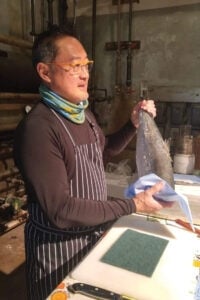 Ian Lai at a “Fin to Fork” food skills workshop on salmon at the Gulf of Georgia Cannery in Richmond, BC.
Mobilizing municipalities
Meanwhile, there are many steps cities can take to promote inclusive food systems within their perimeter. Some municipalities, such as the City of Victoria, have relaxed bylaws on selling produce, making it easier and cheaper for urban farmers to sell their produce at markets or from their own homes.
The City of Victoria has also appointed a municipal food systems coordinator—a move that Dring sees as key to ensuring enough resources are dedicated to supporting inclusive dialogue around food.
According to Dring and Lai, the creation of multicultural food policy councils, inter-agency working groups, and citizen’s advisory boards are other positive steps that cities can take to make discussions around food more inclusive. Cities can also work directly with various ethno-cultural groups to strengthen their capacity to engage with food systems.
Grandmothers know best
Sometimes, this engagement can be as simple as sharing the history of another culture’s foods and traditions. For example, Richmond Multicultural Community Services ran a program that convened grandmothers from diverse backgrounds with the city’s mayor and senior municipal staff.
Each grandmother cooked a traditional dish and presented participants with the personal and cultural history behind it. Over the contented clink of cutlery, the grandmothers also took the opportunity to speak to city staff directly about challenges facing their communities.
“This type of dialogue is invaluable,” says Dring. “Appreciating the diversity of our cultures, as manifested through food, strengthens our society.”
Food security in an urban context
Food security, as defined by the United Nations, “exists when all people, at all times, have physical, social, and economic access to sufficient, safe, and nutritious food which meets their dietary needs and food preferences and allows them to live an active and healthy life.”
It’s a multidimensional construct that intersects with increasing trends of climate change, urbanization, and globalized food systems. As a result, cities, rather than rural areas, are emerging as the new locus of food security research and policy.
Canada is a highly urbanized nation: 82 percent of Canadians live in large and medium-sized cities. And Canada’s cities are multicultural: one in five Canadians was born in another country, and most of these immigrants reside in metropolitan areas. These dynamics play into how we should seek to understand and shape urban food systems.
“Everyone eats,” says Ian Lai, executive director of Richmond Food Security Society (RFSS). “We want to be able to eat what our own cultures dictate as valuable and healthy.”
It happens here too
One in eight households in Canada is food insecure, totalling more than 4 million Canadians.
Room at the table
Unfortunately, many local food movements have failed to account for the needs and interests of Canada’s diverse cultures, as well as people from a range of income brackets. “In our communities, those who have power hold the right to shape the story of what food should be,” says Lai. “The slow-food, farm-to-table movement is largely a privileged one, and a lot of voices get lost within that.”
Colin Dring, a former RFSS executive director turned doctoral candidate at the Centre for Sustainable Food Systems at the University of British Columbia, agrees. “When we talk about things like farmers’ markets, there’s often a lack of cultural engagement,” he says. “We can change this by leaning into our society’s differences and approaching other food paradigms with curiosity.”
According to Dring, a lack of inclusivity results in the creation of parallel food systems that don’t necessarily engage with local movements. To counter this, Lai says that it’s all about looking at who isn’t at the table and thinking of ways we can make their food traditions feel acknowledged, honoured, and respected.
Get your hands dirty
For many city dwellers, it’s easy to feel like a concrete jungle is engulfing us—but contributing to local food systems can begin in our own space. Planting a small urban garden, whether in a yard or on a balcony, promotes biodiversity. Short on gardening space? Something as simple as growing flowers supports the pollination of other plants nearby, while the internet offers a wealth of tips on building vertical gardens in tight spaces. Even better, get your neighbours on board for a collaborative project.
If you have time to spare, consider engaging with municipal or food policy council discussions in your local area.
Urban farming across Canada
From coast to coast, there are plenty of opportunities to get involved with an urban farming initiative near to you.
- Black Creek Community Farm, Toronto: provides access to farmland and discounted fresh produce to low-income families and runs a range of education and engagement programs.
- Chain Reaction Urban Farm, Saskatoon: grows high-quality organic food in the heart of Saskatoon by converting unused space into productive gardens.
- Sole Food Street Farms, Vancouver: transforms vacant urban land into street farms and empowers individuals with limited resources by providing jobs and agricultural training.
- Fort Whyte Farms, Winnipeg: works with Winnipeg youth to build confidence and leadership skills and provide employment training through sustainable urban agriculture.
Community-oriented solutions
The Sharing Farm’s Family Food Skills program focuses on magnifying these voices. Funded by the United Way and based in Richmond, BC, the program seeks to bring newcomers to Canada, as well as lower-income families,
together to create positive stories around food. Each week, participants are supplied with fresh vegetables from the farm and exchange techniques on how to cook them.
“We would often hear that many people would pass on a vegetable due to lack of knowledge on what it tastes like and how to prepare it,” says Sharing Farm administrator Leslie Williams. “We wanted to create a space for diverse members of the community to come together and connect over food.”
Participants’ children took part in educational outdoor programs during the cooking session, allowing families who normally can’t access childcare to attend. In previous years, the Sharing Farm has also run a program for a Somali women’s empowerment group, who were provided with city land to grow their own traditional vegetables.
Lai cites similar types of initiatives as the main driver in engaging diverse ethno-cultural communities in food policy discussions. At RFSS, outreach efforts focus on education, mainly through community gardening, workshops, and mentorship programs within marginalized communities. For example, RFSS partners with the local library to train “seed librarians,” who then supply the public with seeds from a range of cultures and knowledge on how to grow them.
For newcomers to Canada, especially those from war-torn countries, Lai says it’s important to ensure local food movements are a choice—and no one is made to feel guilty for not yet eating locally or participating in community gardening. “Those types of activities are often a glimmer of hope for folks fleeing dangerous places,” says Lai. “It gives them something to aspire to.”
Hitting home
Household food insecurity is especially prevalent in Nunavut, where nearly half of all households are food-insecure.